

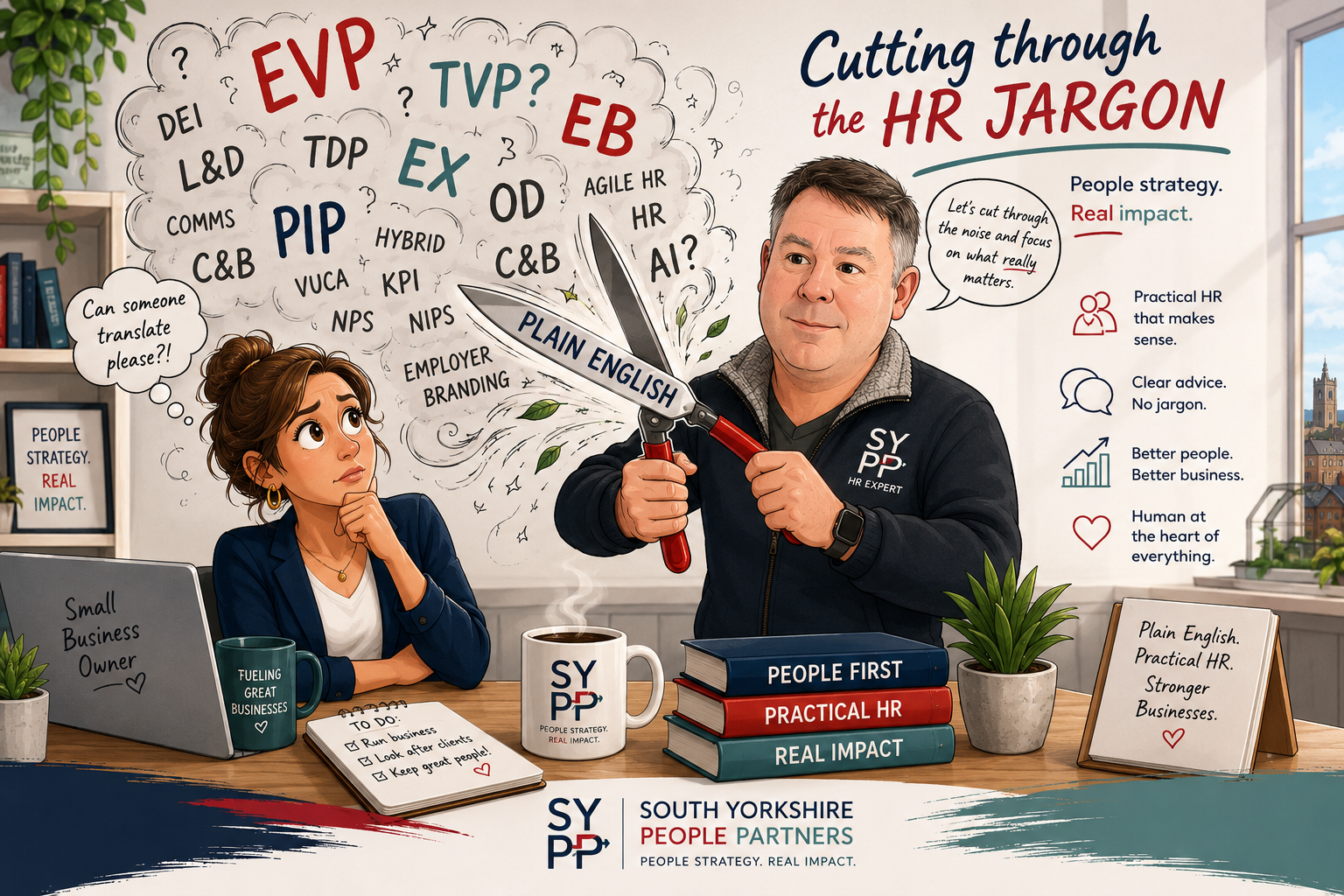
I recently attended a conference and found myself surrounded by a sea of acronyms I didn’t recognise. What struck me was this: if the terminology was going over my head—and I’ve worked in HR for more than 30 years—how difficult must it be for small business owners who are simply trying to build a successful business around their skills and expertise?
For years, I’ve felt that some of the organisations supporting HR professionals have unintentionally made Human Resources seem far more complicated than it needs to be. At times, HR can appear wrapped in layers of terminology, frameworks and buzzwords that make it feel inaccessible to anyone outside the profession. For business owners who only deal with HR because they’ve grown enough to employ people, that can be incredibly off-putting.
That’s not to say HR is always simple. In fact, with employment law and workplace regulations constantly evolving, getting HR right is more important than ever. Good HR support can be invaluable, even for the smallest businesses. But if we could strip away some of the unnecessary jargon, it would make life much easier for business owners and allow them to focus on what really matters—looking after their people and staying on the right side of the law.
So, what were these mysterious acronyms that left me scratching my head?
The first was EVP, which stands for Employee Value Proposition. Then there was EB, short for Employer Branding. Finally, there was TVP, which in this context meant Talent Value Proposition—although, depending on who you ask, it can also mean Team Value Proposition or Target Value Proposition. Apparently, one acronym simply isn’t enough these days.
Curious, I decided to look up Employee Value Proposition. According to Google’s AI overview, the concept evolved from the marketing term Value Proposition, first coined in 1988, before making its way into the HR world in the early 2000s. Discovering that made me feel slightly older than I’d like to admit because, for years, I’ve happily referred to an employer’s attractions as its USP—its Unique Selling Point. It seems the terminology has moved on, even if some of us are still catching up.
The reality is that an EVP is simply the answer to a straightforward question: Why would someone want to work for your business rather than someone else’s? It’s your pay, benefits, culture, flexibility, opportunities for development, and everything else that makes working for you worthwhile. Not quite as mysterious when you put it like that.
At times, HR can feel as though it exists in a parallel universe, accessible only to those who have completed the secret training and learned the language. My aim is the opposite. I want to help business owners navigate the people side of their business without needing a dictionary of corporate buzzwords at their side.
So, whenever possible, I’ll translate the jargon into plain English. That way, you can focus on the things that really matter: understanding your legal obligations, managing your team effectively, creating a positive workplace, and holding on to great employees for as long as possible.
And if a new three-letter acronym appears next week, we can work out what it means together. After all, there seems to be no shortage of them.